
Mecosta County Arrest Records and Court Charges
Mecosta County arrest records document the moment a person is taken into custody. They note the arresting agency, the date, the booking, and the offense an officer listed at the time. In Mecosta County that agency is often the Sheriff's Office under Sheriff Brian Miller, the Big Rapids Police, or the Michigan State Police. An arrest by itself is only the start. Once someone is arrested, the county Prosecuting Attorney reviews the police reports and decides which formal charges, if any, to file with the court. Those filed charges become the court charge record, kept by the court clerk and tracked as the case moves forward.
The two records live in different places. Booking and custody detail sit on the jail and sheriff side, and the current roster is covered on the Mecosta County inmate records page. The court charges after arrest sit in the case file at the 77th District Court or the 49th Circuit Court. A charge record is narrower than the full case. It shows the offense name, the statute, the level, and the charge status. The complete case file, with pleas, hearings, and the final outcome, appears in the Mecosta County criminal court records.
How to Find Mecosta County Arrest Records and Charges
The main online route for Mecosta County court charges is MiCOURT Case Search. The county Courts and Divisions page links straight to the 49th Circuit Court search for Mecosta County. The statewide portal can show civil, traffic, criminal, domestic, and probate cases, depending on the court type. Charge names, case numbers, and charge status show up in the case history there. Booking and arrest detail do not. For that side, the jail is the direct line at (231) 592-0156, answered 24 hours a day.
- Open the Mecosta County MiCOURT link and confirm the court reads 49th Circuit Court, Mecosta County.
- Choose a search mode and enter a defendant name, or the case number if it is known.
- Open the matching case and read the list of charges filed against the defendant.
- Check each charge for its statute code, level, and current status in the register of actions.
State-level lookups add another layer. The Michigan State Police run ICHAT, a public criminal-history tool that reports convictions from across the state. For District Court matters, the 77th District Court criminal and traffic line is (231) 592-0794. Felony questions can go to the 49th Circuit Court at (231) 592-0780. When a name search returns nothing, check the spelling, drop optional filters, and try the statewide MiCOURT entry page.
How Mecosta County Charges Get Filed After an Arrest
After an arrest, the charge record begins when a charging document is filed. In Mecosta County the Prosecuting Attorney, Jonathan Peterson, reviews the law-enforcement reports first. An arrest does not guarantee a charge. The prosecutor may authorize, reduce, add, or decline charges based on the evidence. When charges go forward, they arrive in one of three main forms. A complaint is common for misdemeanors and starts many cases. An information is the prosecutor's felony charging document, filed after a District Court bindover. An indictment comes from a grand jury and is used for serious felonies.
| Complaint | Information | Indictment | |
|---|---|---|---|
| Filed By | Officer / Prosecutor | Prosecutor | Grand Jury |
| Common For | Misdemeanors | Many felonies | Serious felonies |
| Starts | The case | The case | The case |
In felony cases, the same conduct can move from a District Court complaint to a Circuit Court information as the case is bound over. That shift is common, so a single arrest may show up under more than one charging document over the life of a case.
Mecosta County Charge Status Explained
Charges are not fixed once filed. As a case moves, a charge can be amended, reduced, added, dropped, or dismissed. The status field in the case history records where each count stands. Reading it correctly matters. A filed charge and a resolved charge tell very different stories. A handful of terms show up again and again across Mecosta County criminal files.
| Status | What It Means |
|---|---|
| Pending | The charge is filed and active. The case has not yet reached a plea, trial, or dismissal. |
| Amended / Reduced | The prosecutor changed the charge, often to a lower offense or a different count. |
| Dismissed | The court dropped the charge. It may be dismissed with prejudice or without prejudice. |
| Nolle Prosequi | The prosecutor formally declined to pursue the charge, which ends that count. |
Note: A dismissed or set-aside charge can still appear in older copies of a record, so confirm the current status with the court clerk before relying on it.
Charges vs. Convictions
A charge is an accusation. A conviction is a finding of guilt. The gap between the two is the heart of a fair reading of any Mecosta County charge record. A person can be charged, then see the charge dismissed, reduced, or resolved without a conviction. Treating a filed charge as proof of guilt is both unfair and inaccurate.
| Charge | Conviction | |
|---|---|---|
| Stage | Accusation | Verdict or plea |
| Burden of Proof | Probable cause | Beyond reasonable doubt |
| Public Record | Yes | Yes |
Both a charge and a conviction can appear in public records. Only a conviction, though, reflects a court's final judgment of guilt.
Sealed Records and Set-Aside Convictions
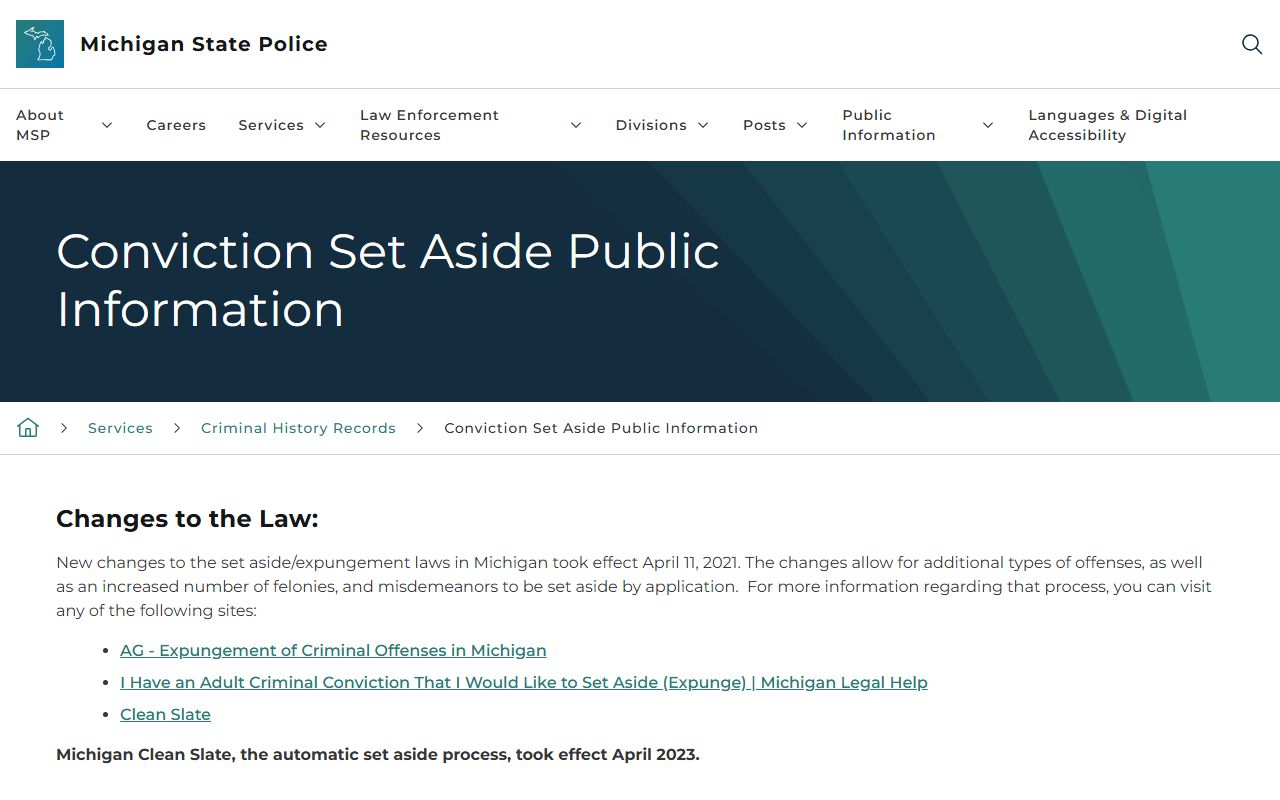
Some Mecosta County charge records are removed from public view. Michigan uses two related ideas. A court can seal a case or a document so it stays out of the public file. Separately, a person can apply to set aside an eligible conviction, which is Michigan's version of expungement. The Michigan State Police explain the process and the Clean Slate changes that expanded who qualifies.
The Michigan State Police keep a public overview of how a set-aside works and who is eligible; the MSP conviction set-aside page lays out the current rules.
A set-aside makes an eligible conviction nonpublic, but law enforcement and courts can still see it. It is not the same as erasing every trace of a charge.
| Sealed Record | Set-Aside Conviction | |
|---|---|---|
| Public View | Hidden by court order | Removed from public criminal history |
| Law Enforcement | Limited access retained | Still available to police and courts |
| How It Happens | Court seals under court rule | Application or automatic Clean Slate |
| Eligibility | Case-specific, the judge decides | Set by MCL 780.621 |
Michigan Courts form MC 227 is the standard application to set aside a conviction. The filing court depends on the conviction. Misdemeanors usually go back to the 77th District Court, and felonies to the 49th Circuit Court where the case was decided.
Mecosta County Charge Codes and Severity Levels
Every charge ties to a statute. The charge record lists the offense name and the Michigan law it violates, plus a level that signals how serious it is. Michigan sorts offenses into felonies, misdemeanors, and civil infractions. Felonies carry the highest penalties and move through the 49th Circuit Court after a felony bindover. Misdemeanors usually stay in the 77th District Court. Civil infractions, such as most traffic matters, are not crimes at all. One arrest can produce several separate charges, each with its own code, level, and status.
Case numbers follow a set pattern. Under Michigan Court Rule 1.109, a case caption uses a year prefix and a two-letter case-type code assigned by the state court administrator. Reading that code tells you the kind of case at a glance. The same caption also names the court, the parties, and the charge or title of the action.
Statewide Charge and Criminal History Lookups
Individual charges roll up into a statewide criminal history over time. The Michigan State Police keep that record and open part of it to the public through ICHAT, the Internet Criminal History Access Tool. An ICHAT search returns public conviction records for a fee. It does have limits. ICHAT does not show warrant information, and it does not include suppressed or set-aside records.
The Michigan State Police outline what a criminal-history search does and does not include; the MSP Criminal History Records page is the official starting point.
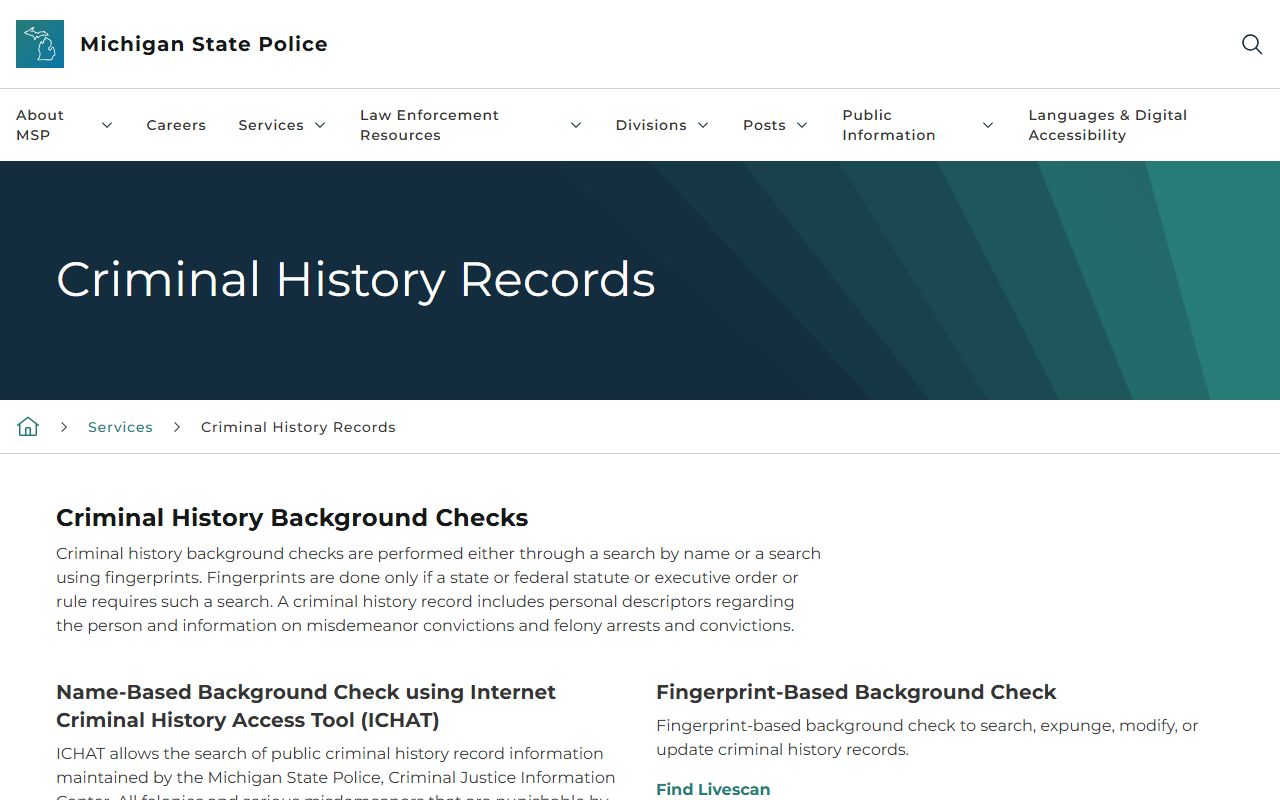
That page feeds directly into the public ICHAT tool, where a name-based search of Michigan convictions can be run. The Michigan ICHAT portal hosts the search itself.
For people under state corrections supervision, a different tool applies. The Michigan Department of Corrections runs OTIS, which lists prisoners, parolees, and probationers. A person arrested in Big Rapids yesterday may not appear in OTIS, so the Mecosta County Jail stays the direct check for current custody.
Background Check Considerations
A casual name search is not the same as a formal background check. Employers, landlords, and licensing bodies that make decisions about a person must follow the federal Fair Credit Reporting Act. That law sets rules for accuracy, consent, and dispute rights when a consumer report is used. A public MiCOURT or ICHAT lookup done out of curiosity does not carry those protections and should not be treated as a compliant screening.
Important: This site is not a consumer reporting agency under the Fair Credit Reporting Act, and its information cannot be used for employment, tenant, or credit screening.
Restricted Charge Records in Mecosta County
Not every charge is open to public view. Juvenile charges are handled through the Family Court Juvenile Division and are shielded from the open search that adult cases allow. Questions there go to (231) 592-0131 rather than a web portal. Set-aside convictions drop out of the public record once a court grants the application. Some dismissed charges and details tied to an active investigation may be withheld as well.
When a search comes up empty, that does not always mean no record exists. It may mean the record is restricted, sealed, or held by a court that does not publish it online.