
What Probate Covers in Mecosta County
The 18th Probate Court hears probate matters for Mecosta County. Probate is the legal process that transfers a person's property after death, but the court's work reaches well beyond estates. It appoints personal representatives, proves and interprets wills, and supervises the people who manage money or care for others under a court order. The same court also handles Michigan mental health code cases and requests to open a sealed safe deposit box.
Most residents encounter probate when a family member dies and someone must settle the estate. Others come to the court to set up a guardianship for a minor or an incapacitated adult, or a conservatorship to manage another person's finances. The court's official probate FAQ is detailed and answers many common questions about opening a file, storing a will, and getting certified copies.
The main case types the 18th Probate Court manages include the following.
- Decedent estates and appointment of personal representatives.
- Wills, including will safekeeping before death.
- Guardianships of minors and incapacitated adults.
- Conservatorships and other protective proceedings.
- Trust proceedings.
- Mental health code cases.
- Safe deposit box petitions.
Probate Terms Defined
Probate paperwork uses words that rarely appear in daily life, and the meaning of a filing often turns on them. A few core definitions make estate and guardianship files far easier to read. The terms below come up in nearly every Mecosta County probate case.
- Testator
- The person who made the will. The estate follows that person's written instructions when a valid will exists.
- Executor
- The person named in a will to carry out its terms. Michigan courts formally call this role the personal representative.
- Intestate
- Dying without a valid will. State law then decides who inherits and in what shares.
- Guardianship
- A probate case that appoints someone to make personal or care decisions for a minor or an incapacitated adult.
- Conservatorship
- A protective proceeding that appoints someone to manage the property and finances of a protected person.
How to Search Mecosta County Probate Records
There is no standalone public online probate search form for Mecosta County. The statewide MiCOURT Case Search portal may show some probate case activity depending on the court and case type, but many probate files are requested directly from the court. To confirm a case or order copies, the reliable routes are email, phone, and the counter at 400 Elm Street.
The 18th Probate Court accepts case lookups by email at MCprobatefamilycourt@18thprobatecourt.org or by phone at (231) 592-0135. Give staff as much identifying detail as possible so they can locate the right file. The channels below cover how each request works.
| Field Label | Type | Required | Options / Format Notes |
|---|---|---|---|
| Email to MCprobatefamilycourt@18thprobatecourt.org | Email request | Required for the email route | Include decedent, ward, or protected person name, case number if known, approximate year, and the record requested. |
| Phone (231) 592-0135 | Phone request | Required for the phone route | Ask Probate Court staff for the search and copy-request procedure. |
| In-person counter | Walk-in request | Optional | Probate Court window at 400 Elm Street, Big Rapids. |
Note: Confidential mental health, juvenile, and sealed probate matters are not open to general public search, so some requests return limited results.
Mecosta County Probate Court Office
The 18th Probate Court sits inside the Mecosta County Building at 400 Elm Street in Big Rapids, the county seat. Hon. Tyler Thompson serves as probate judge, and Julia A. Wallace is the Probate and Family Court Administrator. The office also holds the county's family court juvenile matters, so its counter handles more than estate files.
18th Probate Court
400 Elm Street
Big Rapids, MI 49307
(231) 592-0135
Monday to Friday, 8:30 a.m. to 5:00 p.m.
Staff cannot give legal advice or recommend an attorney, and they cannot discuss a matter with the judge outside of a court session. For help drafting a will or understanding a case, the court points people to a licensed attorney or to Michigan Legal Help. Certified copies, forms, and case lookups are handled at the window.
How Probate Works in Mecosta County
Every probate matter follows a broadly similar path, though the exact steps depend on the case type and whether the estate is handled formally or informally. The walkthrough below reflects the general order the 18th Probate Court uses.
- Determine the case type: estate, guardianship, conservatorship, trust, mental health, will safekeeping, or safe deposit box.
- Get the correct SCAO forms from the Probate Court window or the Michigan Courts form search.
- File the petition or application at 400 Elm Street and pay the opening fee. Most new files cost $175 to open, but verify the amount for your case type.
- The court schedules any required hearing or processes informal estate filings, depending on the matter.
- The personal representative, guardian, or conservator receives letters or an order once appointed.
- File inventories, accountings, claims, and notices as the case requires. Inventory fees depend on estate value and are not waivable.
- For public copies or searches, email or call the court. Expect access limits on confidential mental health, juvenile, and sealed matters.
Mecosta County Probate Filing Fees
Probate fees follow Michigan's statewide fee and distribution schedule, though the court's FAQ notes most new files cost about $175 to open once system and electronic filing charges are added. Opening an estate, a guardianship, or a conservatorship generally carries the same base petition fee. The most common charges are listed below.
| Item | Amount |
|---|---|
| Petition to commence an estate or appoint a personal representative | $150 (most new files run $175 to open) |
| Guardianship petition | $150 |
| Conservatorship or protective order petition | $150 |
| Trust proceeding (separate proceeding) | $150 |
| Motion, objection, amended petition, or petition for instruction | $20 |
| Demand for jury trial | $30 |
| Petition for assignment of a small estate | $25 plus inventory considerations |
| Petition to open a safe deposit box | $10 |
| Will filed for safekeeping | $25 |
| Certified copy of Letters of Authority (two pages) | $12 |
Note: Inventory fees are set by the value of the estate and cannot be waived under the fee schedule, so a larger estate pays a larger inventory fee.
Will Safekeeping and Letters of Authority
One local service that surprises many residents is will safekeeping. Michigan does not require anyone to file a will with the court before death. The 18th Probate Court will, however, store a will in its vault inside a sealed envelope for a $25 fee. That deposit is strictly confidential and cannot be opened until the maker dies.
While the maker is living, only that person controls the deposited will. The depositor may view it, exchange it for an updated version, remove it, or authorize another person to act using a state court form. The sealed vault gives families a secure, court-held location that avoids a lost or destroyed original.
Certified Letters of Authority prove a personal representative's power to act for an estate. A standard two-page set costs $12, which reflects the $10 certification charge plus $1 per page. Banks, title companies, and other institutions usually require these certified letters before they release estate assets.
Probate Forms and SCAO Filings
Michigan probate cases use standardized forms approved by the State Court Administrative Office, known as SCAO forms. The 18th Probate Court supplies these forms at its counter, and the same forms are available through the Michigan Courts form search online. Using the correct SCAO form for the case type keeps a filing from being rejected.
Common forms cover estate petitions, letters of authority, inventories, annual accountings, guardianship and conservatorship petitions, and will deposit paperwork. Court staff can hand out the forms but cannot tell a filer which one to choose or how to complete it. People who want guidance are directed to an attorney or to Michigan Legal Help, and the county's Courts and Divisions page links the probate FAQ and family court resources.
What Mecosta County Probate Records Show
A probate file collects every document filed as a case moves from opening to closing. For a decedent estate, that record traces how property was gathered, valued, and passed to heirs or beneficiaries. Guardianship and conservatorship files instead track who was appointed, what powers they hold, and how they report back to the court.
The contents of a typical estate or protective file include the items below.
- The petition or application that opened the case and the case number.
- The will, if one was admitted, and any codicils.
- Letters of Authority naming the personal representative, guardian, or conservator.
- An inventory of estate or protected-person assets.
- Annual accountings and reports on how funds were handled.
- Claims filed by creditors and notices to interested parties.
- Orders of distribution and the order closing the case.
Michigan Court Rule 1.109 requires filers to protect sensitive identifiers, so dates of birth, Social Security numbers, and financial account numbers are redacted from the public version of a file. Family records tied to a divorce or marriage are kept by a different office, and the county's vital records and marriage details sit with the Mecosta County marriage and divorce records.
Bankruptcy Cases Are Not Probate Matters
People sometimes assume the county Probate Court handles bankruptcy because both deal with debts and assets. It does not. Bankruptcy is a federal matter, heard by the U.S. Bankruptcy Court for the Western District of Michigan, which covers Mecosta County. Those filings include Chapter 7, 11, 12, and 13 cases, along with claims, schedules, discharge orders, and adversary proceedings.
The federal bankruptcy court publishes filing information and rules on its own site; the U.S. Bankruptcy Court for the Western District of Michigan homepage is the starting point for local filers.
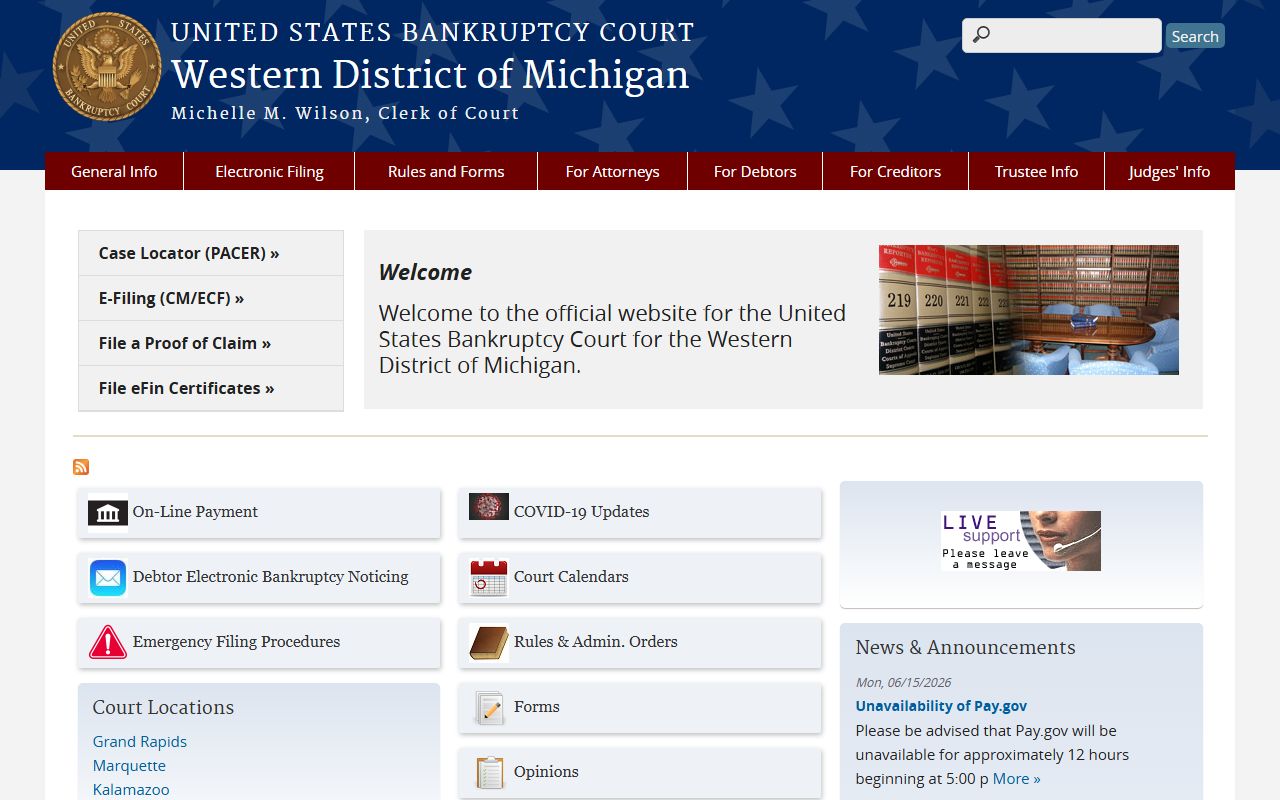
That court sits at One Division N., Room 200, in Grand Rapids and answers at (616) 456-2693, a separate office from the 400 Elm Street probate counter.
Federal case documents are stored in the PACER system rather than in any county file. Registration is required, and fees may apply to viewing dockets or pulling documents. The PACER court lookup for the Michigan Western Bankruptcy Court confirms the court's contact details and electronic filing access.
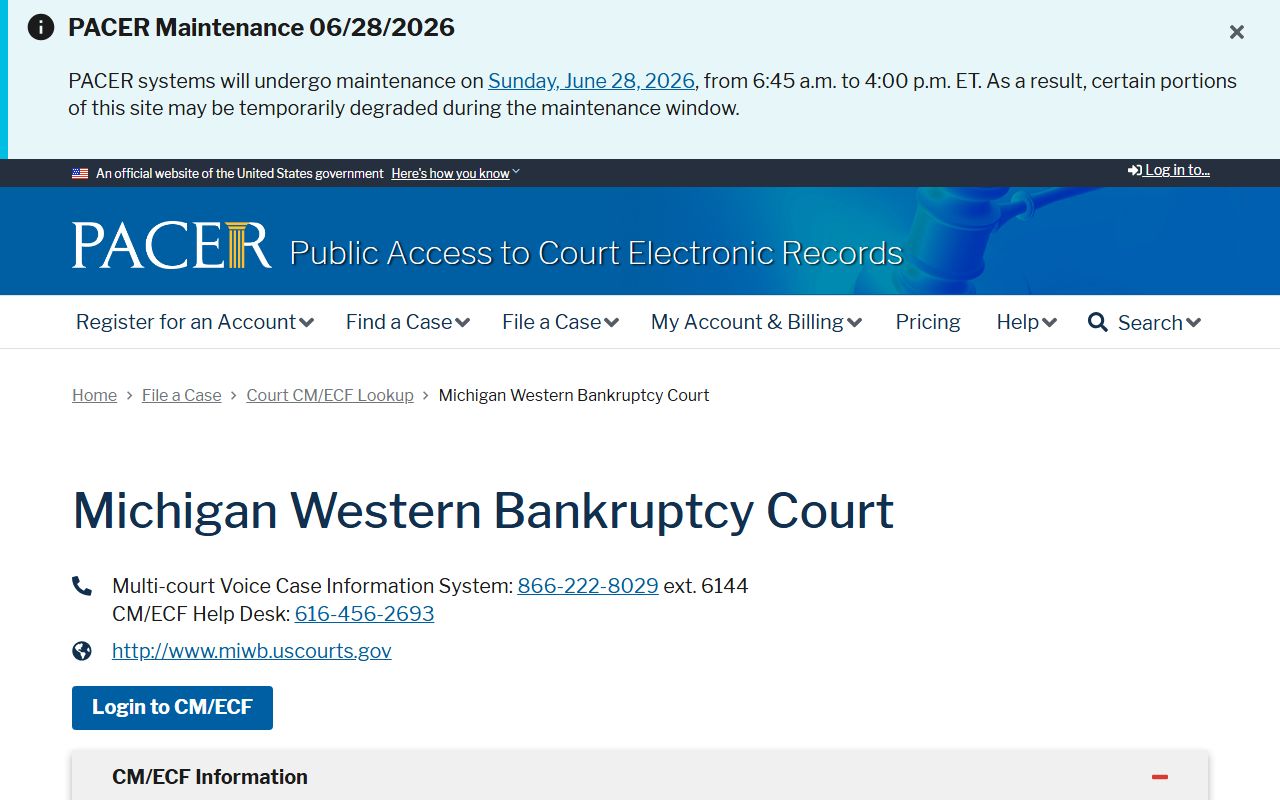
PACER is the correct tool for federal bankruptcy, not for the estate and guardianship files that stay with the county Probate Court.
Appeals also route differently. A decision from a Mecosta County probate case is reviewed within the Michigan state court system, while a federal case from the Western District moves up to the U.S. Court of Appeals for the Sixth Circuit. The U.S. Court of Appeals for the Sixth Circuit hears those federal appeals for Michigan and several neighboring states.
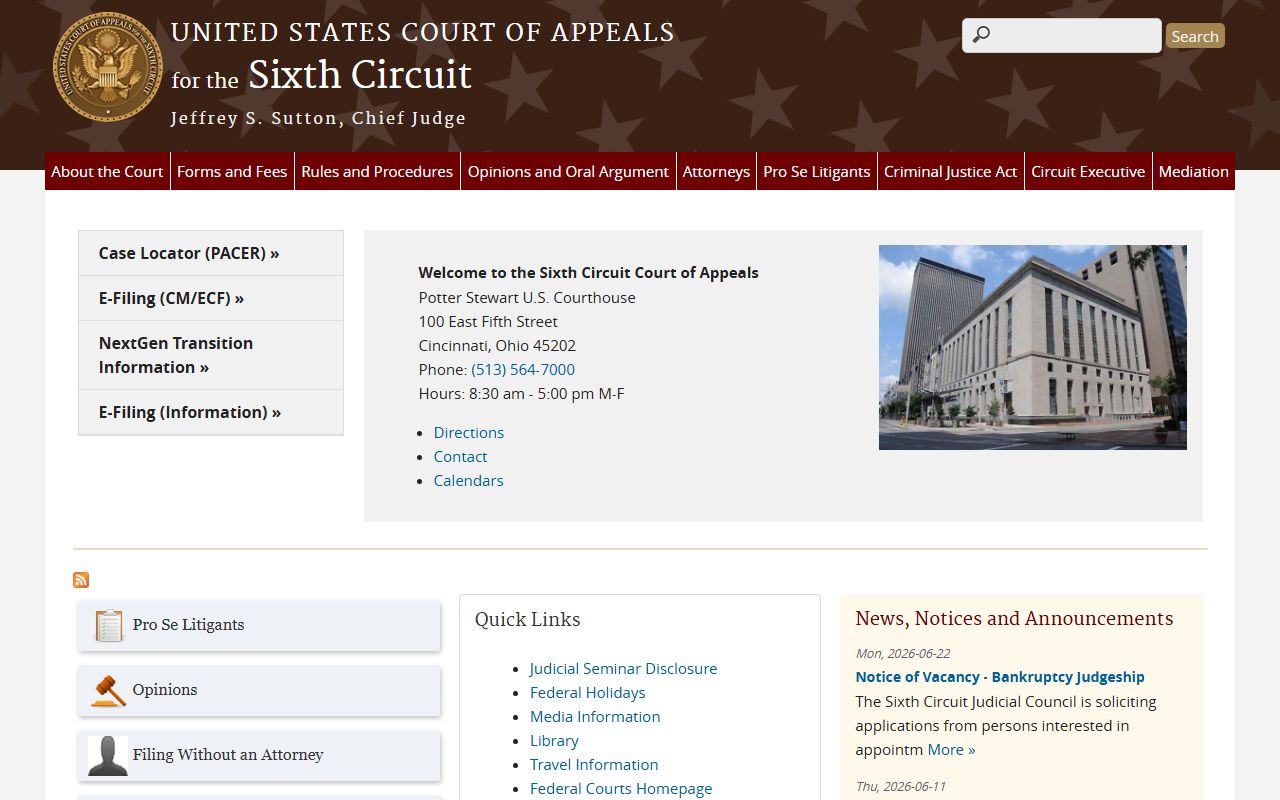
Knowing which court holds a record, state or federal, saves a wasted trip to the wrong counter or portal.
Restricted Mecosta County Probate Records
Not every probate document is open to the public. Mental health code cases carry statutory confidentiality, so those files are not general public records and are not returned in a routine search. The same court that hears estates handles these commitments, but the two record sets are treated very differently.
Juvenile matters within the family court division are likewise closed, and adoption records are highly restricted under Michigan law. Access to court records generally follows Michigan Court Rule 8.119, while broader county administrative records fall under the state's Freedom of Information Act at MCL 15.233. Anyone unsure whether a probate file is open should ask the court before assuming it can be released. For related filings held by the county's records office, the Mecosta County Clerk is the point of contact for vital records and certified copies outside the probate division.