
Criminal Court Records in Mecosta County
A criminal court record is the case file the court opens once a criminal charge is filed. It is not the arrest report and it is not a background-check summary. It is the running account of one prosecution, from the charging document to the judgment. The court clerk maintains this file, adds each new filing, and logs every hearing in a register of actions. For the charging document itself and how charges change after an arrest, the Mecosta County arrest records and court charges page covers that narrower record.
Two trial courts produce these files in Mecosta County. The 77th District Court handles misdemeanors, arraignments, preliminary examinations, and the early stages of felony cases. The 49th Circuit Court, shared with Osceola County, handles felony prosecutions once a case is bound over from the district level. A single serious case can leave events in both files: it begins in district court and continues in circuit court. Misdemeanors and traffic misdemeanors usually stay in district court from start to finish.
How to Search Mecosta County Criminal Court Records
The official online route is MiCOURT Case Search, the statewide public case portal. The county Courts and Divisions page links directly to the 49th Circuit Court search for Mecosta County. The statewide entry point states that criminal, traffic, civil, domestic, and probate cases may appear depending on the court type. District Court criminal and traffic questions go to a separate line, and probate cases are searched by email or phone rather than the same portal.
- Open the county's MiCOURT 49th Circuit Court case search link and confirm the court shows as Mecosta.
- Choose the search mode and enter the defendant name or the court case number.
- Narrow the results with case-type or date filters if the portal displays them.
- Open the matching case to read the register of actions, plea, and disposition.
- Request a certified copy from the court clerk if the record is needed for legal use.
For a statewide criminal-history summary, the Michigan State Police run ICHAT, the Internet Criminal History Access Tool. ICHAT reports public conviction history across Michigan, but it is a separate database from the court case file. It does not show warrant information and does not include suppressed or set-aside records. A full case file with motions and hearing detail still comes from the court that heard the case. The broader Mecosta County court records portal covers civil and other case types alongside criminal matters.
Stages of a Criminal Case in Mecosta County
A criminal case moves through fixed stages, and each stage leaves a mark in the record. Charges begin when the prosecutor authorizes a complaint after reviewing a police report. The clerk opens a file, assigns a case number, and the defendant is brought in for a first appearance. From there the case advances toward a plea or a trial, then to a sentence if there is a conviction. Felony cases add a preliminary examination and a bindover step that shifts the file from district to circuit court.
Case flow: Charges Filed › Arraignment › Preliminary Exam / Bindover › Pretrial / Motions › Plea or Trial › Disposition › Sentencing
| Stage | What Happens |
|---|---|
| Arraignment | The defendant hears the charges, enters a first plea, and the judge sets bond and release conditions. Felony arraignments start in the 77th District Court. |
| Preliminary Exam / Bindover | In felony cases the district court weighs probable cause. If it is met, the case is bound over to the 49th Circuit Court on an information. |
| Pretrial / Motions | Attorneys exchange evidence, file motions, and negotiate. Orders on suppression, bond, and scheduling are entered in the file. |
| Plea or Trial | Most cases end in a plea. Others go to a bench or jury trial where guilt is decided beyond a reasonable doubt. |
| Sentencing | After a plea or a guilty verdict the judge imposes fines, costs, restitution, probation, jail, or prison, and the terms enter the record. |
What a Mecosta County Criminal Court Record Shows
Michigan Court Rule 1.109 sets what a filed document must carry, and that structure shapes every criminal file. The caption names the court, lists the parties, and states the case number. Michigan case numbers use a year prefix and a two-letter case-type code assigned by the State Court Administrative Office. From there the file builds out with the charging document, bond information, each plea, the motions, the disposition, and the sentence. Register-of-actions entries log the case in date order.
| Field | What It Shows |
|---|---|
| Case Number | Year prefix plus a two-letter case-type code identifying the court and the type of criminal matter. |
| Court | 77th District Court, 49th Circuit Court, or both when a felony is bound over. |
| Defendant | The accused party, listed opposite the People of the State of Michigan. |
| Charges | Offense name, the statute cited, and the level such as misdemeanor or felony. |
| Bond | The amount and conditions set for release pending the case. |
| Plea | Guilty, not guilty, or no contest, with the date the plea was entered. |
| Disposition | The outcome, such as dismissed, pled, convicted, or acquitted. |
| Sentence | Fines, costs, restitution, probation, jail, or prison ordered on conviction. |
Some fields never appear in the public view. Court rules protect personal identifiers such as date of birth, Social Security number, driver's license number, and financial account numbers, which filers must redact or supply separately. Online access in Michigan is generally centered on the register of actions rather than full document images, so a reader who needs a specific motion or order may still have to ask the clerk.
Charges vs. Convictions
A charge is an accusation. A conviction is a proven result. A criminal court record can hold both, and it can also hold charges that were dropped, dismissed, reduced, or that ended in acquittal. Reading the record without that distinction leads to real errors, because a file that lists three original counts may end with a plea to one and dismissal of the rest. The disposition line, not the charge line, tells you what actually stuck.
| Charge | Conviction | |
|---|---|---|
| Stage | Accusation at filing | Verdict or accepted plea |
| Burden of Proof | Probable cause | Beyond a reasonable doubt |
| Can Change | Amended, reduced, or dismissed | Fixed unless appealed or set aside |
| Public Record | Yes | Yes |
Reading Dispositions and Sentences
The disposition is the case outcome, and the sentence is the penalty that follows a conviction. Both appear near the end of the register of actions. A guilty plea, a jury verdict, a dismissal, and a no-contest plea each read differently, and the sentence block then lists the terms the judge ordered. Probation means community supervision; parole is post-prison supervision run by the state corrections department, not the court.
- Guilty / No Contest
- The defendant admits the charge or declines to contest it, and the court enters a conviction.
- Dismissed
- The charge is dropped by the prosecutor or the court; dismissed with prejudice generally cannot be refiled.
- Disposition
- The overall result of the case, such as pled, convicted, acquitted, or dismissed.
- Sentence
- The penalty imposed, which may combine fines, costs, restitution, probation, jail, or prison.
How Mecosta County Prosecutors File Charges
Charges do not begin in the courtroom. The Mecosta County Prosecuting Attorney reviews reports from the Sheriff, Big Rapids police, or the Michigan State Police and decides what, if anything, to file. Jonathan Peterson serves as Prosecuting Attorney, with the office in the County Building at 400 Elm Street, Big Rapids. An arrest does not guarantee a charge on every offense. The prosecutor may authorize, amend, reduce, add, or dismiss counts, and the criminal court record reflects each of those choices.
The charging path also explains why a felony file lives in two courts. Felony charges generally start with arraignment and a preliminary examination in the 77th District Court, then move to the 49th Circuit Court after bindover on an information. Misdemeanors usually stay in district court through disposition. A defendant who cannot afford counsel should ask the court handling the case about appointed-counsel procedures at arraignment.
Federal Criminal Cases from Mecosta County
Some crimes charged against Mecosta County residents are prosecuted in federal court rather than the state system. Mecosta County sits in the U.S. District Court for the Western District of Michigan, with Grand Rapids the nearest federal courthouse. Federal prosecution is handled by the U.S. Attorney's Office for that district, and those files are entirely separate from the 49th Circuit and 77th District records.
The federal prosecutor's office publishes its jurisdiction and leadership online; the U.S. Attorney's Office for the Western District of Michigan covers 49 counties across both peninsulas.
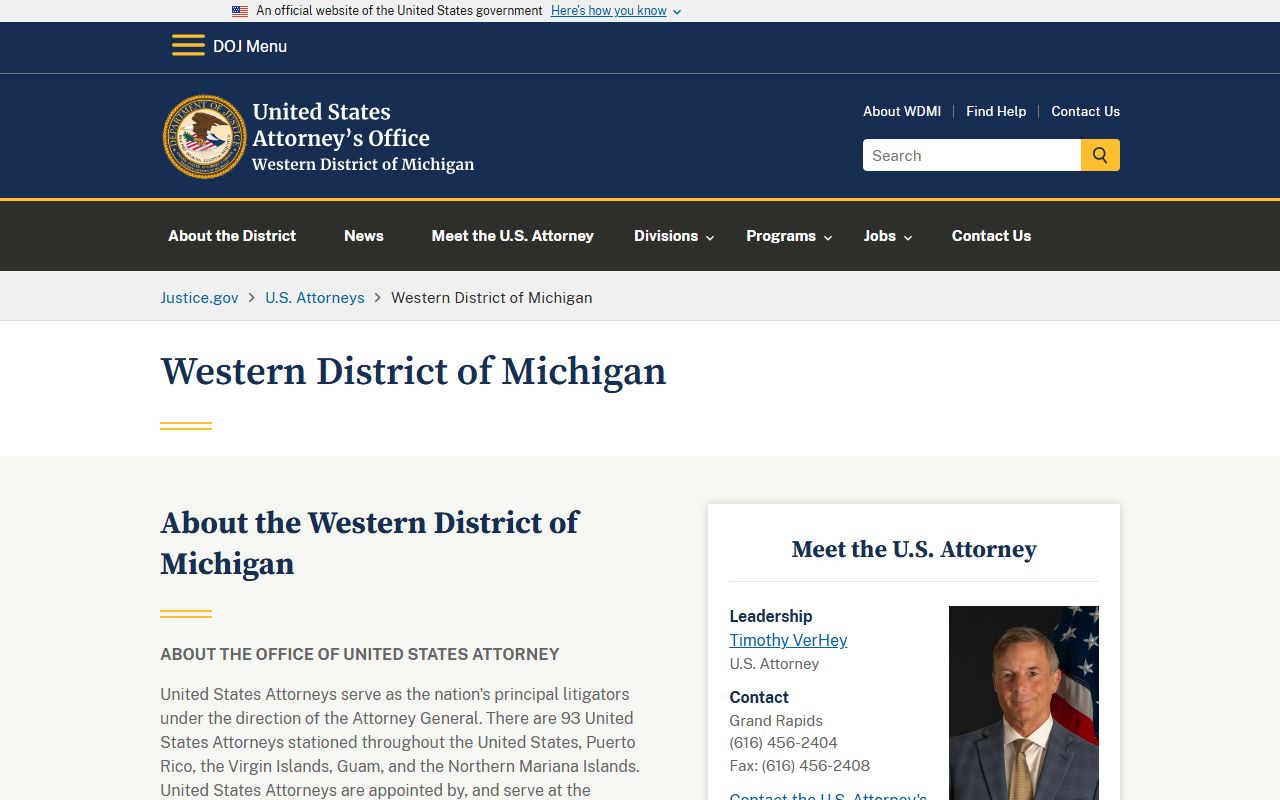
That office decides which cases move to federal court, so a Mecosta County matter can end up on a federal docket rather than a state one. Leadership detail is posted separately on the office's Meet the U.S. Attorney page.
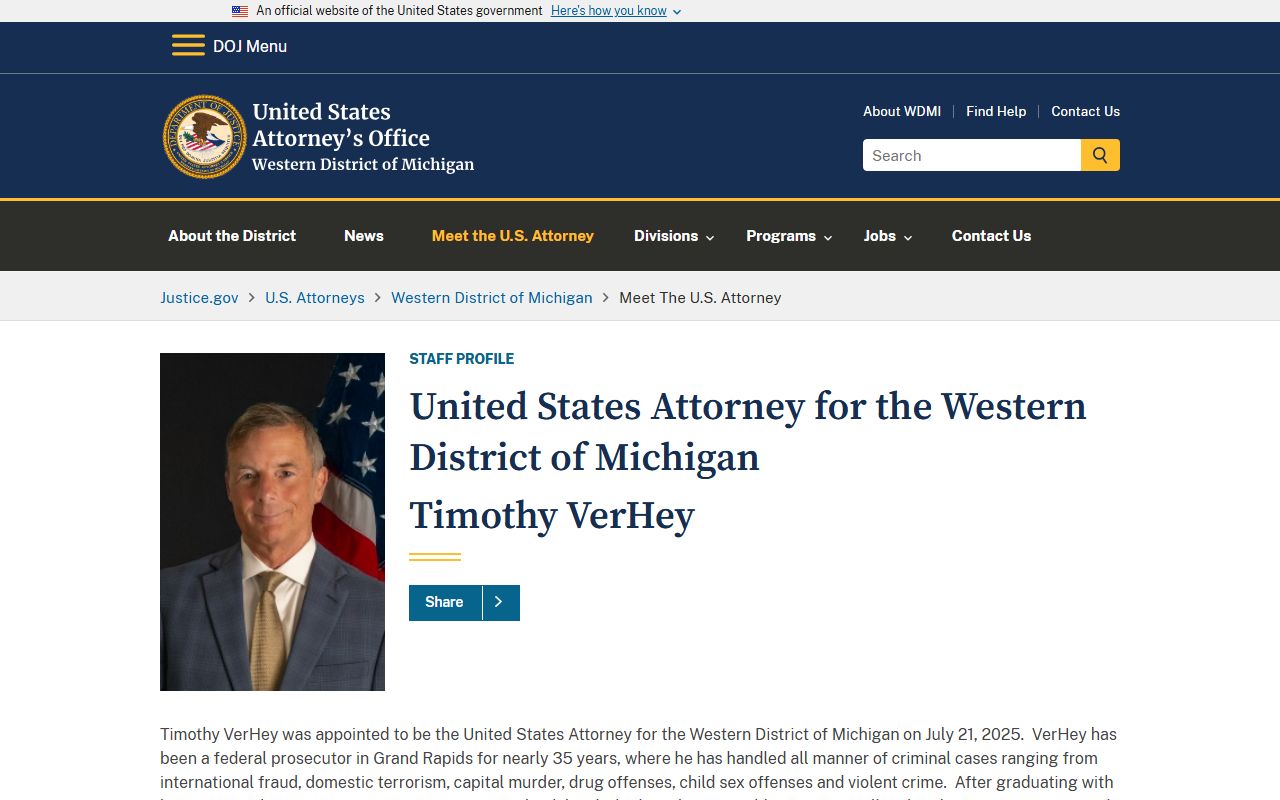
Federal case files are searched through PACER and CM/ECF rather than MiCOURT, and access there may require a registered account. For most residents, though, criminal matters remain in the county's own circuit and district courts.
Sealed vs. Set-Aside Criminal Records
Two different mechanisms can pull a criminal record out of public view in Michigan, and they are not the same thing. A court can make a specific record nonpublic, or "sealed," by order under the court rules, which is narrow and case-by-case. Separately, an eligible conviction can be set aside, which is Michigan's version of expungement and reaches the whole conviction. Set-aside is governed by state statute and the Clean Slate reforms.
Michigan's set-aside law is posted in full by the state legislature; the set-aside statute, MCL 780.621 governs which adult convictions qualify and how the court order removes them from public access.
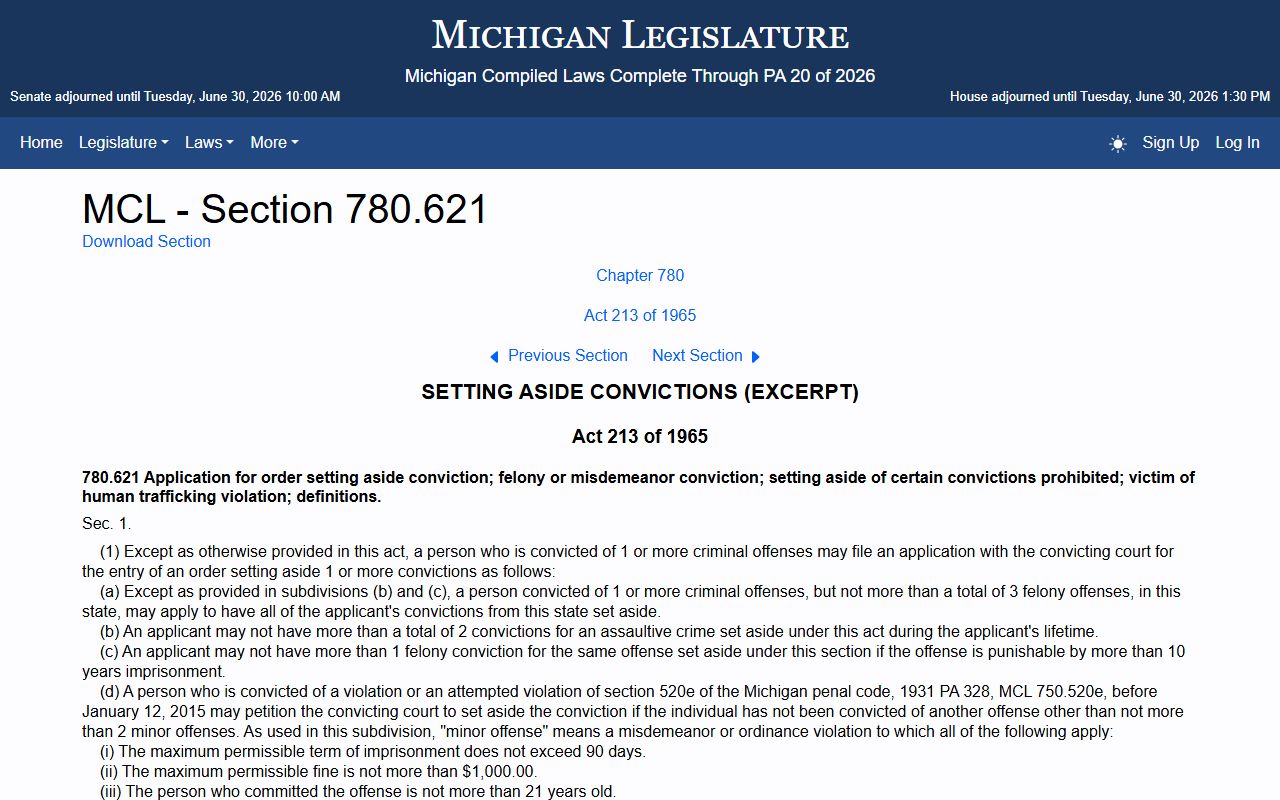
An applicant usually files in the court where the conviction occurred using Michigan Courts form MC 227, unless a different set-aside form applies. Misdemeanors and some criminal or traffic matters route to the 77th District Court, while felonies route to the 49th Circuit Court. Once granted, the conviction is set aside from public view, but authorized law enforcement and courts may still access it, and a set-aside is not the same as destroying every record.
| Sealed | Set Aside / Expunged | |
|---|---|---|
| Visibility | Hidden from public by court order | Conviction removed from the public criminal record |
| Law Enforcement | Limited access | Available to courts and authorized agencies by law |
| Eligibility | Case-specific under the Michigan court rules | Eligible convictions under MCL 780.621; some set aside automatically under Clean Slate |
| How It Happens | Judge's order sealing a specific record | Application on form MC 227, or automatic for qualifying offenses |
Public Access to Mecosta County Criminal Records
Michigan law favors open access to court records, subject to defined exemptions. Adult criminal case files are presumed public unless a rule, statute, or court order makes a record nonpublic. Criminal case records are searched first through MiCOURT or the court division, while county administrative records fall under the Michigan Freedom of Information Act. When a record is a court file rather than a general county record, the court clerk, not the FOIA coordinator, controls how it is released.
Key Statutes:
Michigan MCL 15.233 - Any person may inspect, copy, or receive public records unless an exemption applies, and the request must describe the record clearly.
Michigan Court Rule 8.119 - Governs court records, registers of actions, clerk duties, and access to public and nonpublic court records.
Michigan Court Rule 1.109 - Defines court records, caption requirements, protected personal identifiers, and the sealing procedure.
Background Check Considerations
A casual case lookup and a formal background check are not the same. Pulling a case on MiCOURT or running a name on ICHAT gives a snapshot of public criminal history, but it is not a screened, dispute-ready report. Employers, landlords, and licensing bodies that make decisions on someone's record must use a process that follows the federal Fair Credit Reporting Act, which sets accuracy, notice, and dispute rules that a raw court lookup does not provide.
Important: This site is not a consumer reporting agency under the Fair Credit Reporting Act, and its information may not be used for employment, tenant, credit, or other FCRA-regulated screening.
Restricted Criminal Court Records in Mecosta County
Not every criminal matter is open to the public. Juvenile cases run through the Family Court Juvenile Division and are shielded far more than adult files; those questions go to the division by phone rather than an open search. Set-aside convictions drop out of public access once a court grants the order. Certain filings stay nonpublic under court rule, and protected identifiers are redacted from what the public sees.
Ongoing cases can also be limited. Sealed documents, warrant material that has not been served, and records tied to confidential proceedings may not appear in a public search even though the case exists. When a record does not show up online, the reliable next step is to contact the court that would hold it. The 77th District Court fields criminal and traffic questions on its own line, and the 49th Circuit Court handles felony files, while the County Clerk issues certified copies of records the courts release.